The Pro-Human AI Declaration
March 2026
The Pro-Human AI Declaration





































New Poll: Americans Overwhelmingly Support Pro-Human Principles on AI
A new national survey of 1,004 likely U.S. voters (February 19-20, 2026) reveals where Americans stand on AI development and the principles that should guide it.
The findings show that voters overwhelmingly prefer a future that is pro-human in nature, and reject the AI race focused on human replacement.
Respondents were presented with pairs of opposing statements about the trajectory of AI and asked which they prefer. The results were remarkably clear: across the political spectrum voters reject the current paradigm of rapid, lightly regulated AI development. Instead they want humans to remain firmly in control, children protected from manipulative AI systems, and companies held legally accountable when AI causes harm.
These results come as policymakers grapple with how to govern increasingly powerful AI systems, and as leading AI companies push toward what they call "artificial general intelligence."
Below we summarize the key findings of this report. Click here to view the toplines.
Highlights
- 80% of voters support keeping humans in charge of AI, with strong oversight, clear limits, and corporate accountability—versus just 10% who favor fast, lightly regulated development.
- 77% believe AI must stay under human control, with people deciding what to delegate and retaining the ability to stop systems when needed—versus just 11% who prefer giving AI more independence for speed and scale.
- 69% want to prevent AI monopolies and ensure benefits are shared broadly, not captured by a small group—versus 16% who believe concentration is natural and policy shouldn't punish size with antitrust or forced sharing.
- 73% support protecting children and families from AI systems designed to create emotional attachment or dependency—versus 15% who feel AI should be allowed to serve as tutors, coaches, or companions without strict limits.
- 72% believe AI companies should bear legal responsibility for harms, with clear safety standards and real oversight—versus 15% who want accountability focused narrowly on negligence and fraud, with light oversight and safe harbors.
- 69% agree that superintelligence should be prohibited until there is broad scientific consensus it can be developed safely and controllably—versus just 9% who disagree.
Respondents were presented with competing framings of AI governance—one emphasizing human control and accountability, the other emphasizing speed and minimal regulation—and asked to choose.
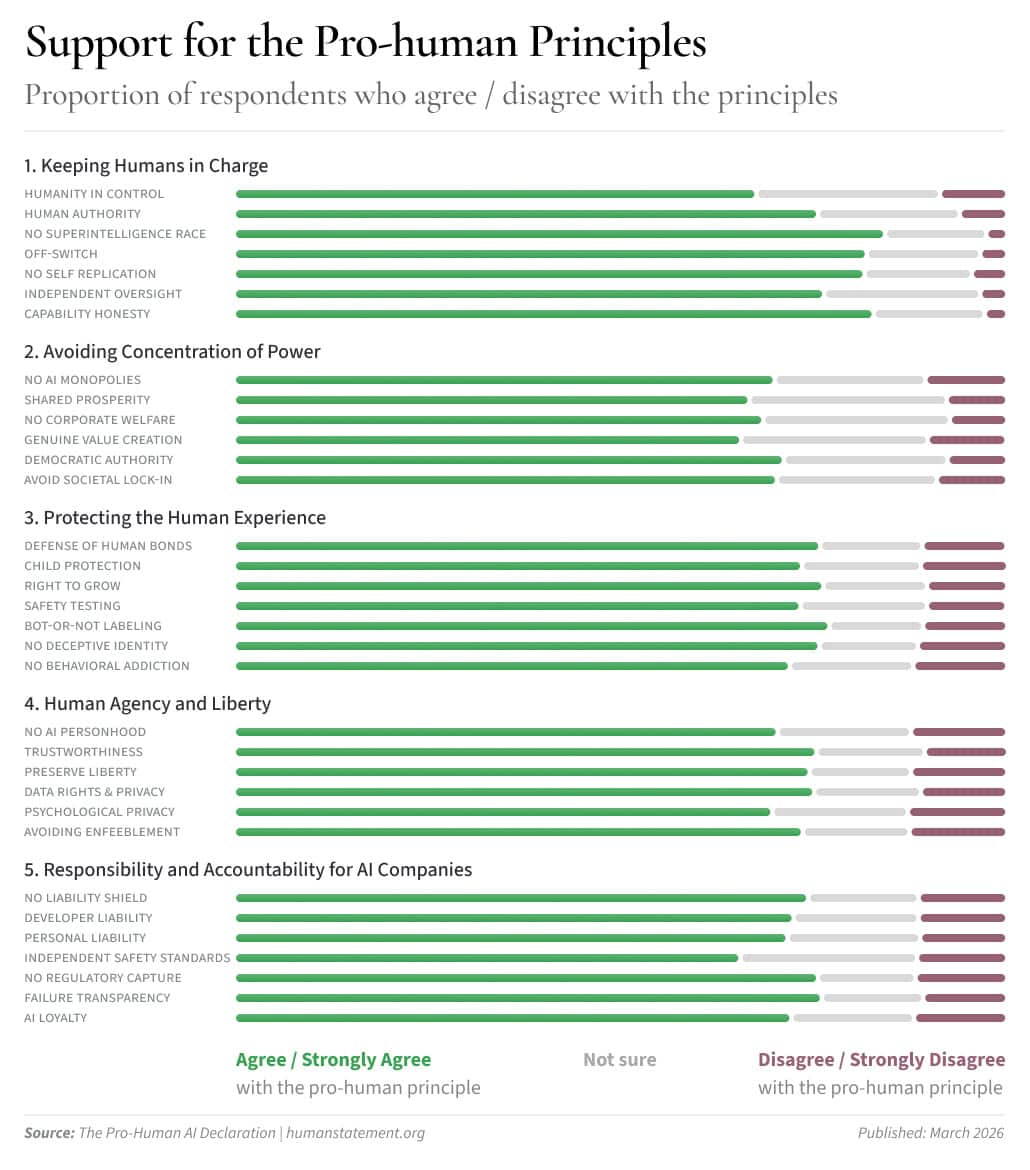
They were also asked to rate their agreement with specific principles across five domains: human control, concentration of power, protecting human experience, human agency and liberty, and corporate accountability.
Bipartisan consensus on AI principles
Notably, these findings cut across partisan lines. The survey sample was weighted to reflect the 2024 electorate, with roughly equal numbers of Trump and Harris voters represented.
The pattern is consistent: while Harris voters show slightly stronger support for oversight and accountability, Trump voters still favor these positions by large margins.
On no issue tested did a majority of either partisan group choose the "fast development, minimal regulation" position.
This bipartisan consensus suggests that AI governance need not be a partisan issue. Voters of all political stripes want humans in charge, children protected, and companies held accountable.
Overall: Voters reject the "race to replace" approach to AI
When presented with two overarching visions for AI development, voters chose decisively.
This 8-to-1 margin represents a clear public mandate: Americans want guardrails on AI development, not a race to the bottom.
And what’s more:
- 89% of Harris voters chose the pro-human-control vision (Statement A);
- 73% of Trump voters chose the pro-human-control vision (Statement A), and of those only 14% preferred the fast, lightly-regulated approach.
On the core question of human control versus fast development, both Democrats and Republicans overwhelmingly chose human control. The same pattern holds across all the specific principles tested.
The finding sits in stark contrast to the operating paradigm of leading AI companies, which openly declare they are racing toward increasingly powerful systems while lobbying against meaningful oversight.
Human control: Non-negotiable for most Americans
The survey tested voter attitudes on several dimensions of human control over AI systems. The results show overwhelming consensus.
On the core question of human control:
- 77% agree that AI must stay under human control, with people deciding what to delegate and retaining the ability to understand what systems are doing and stop them when needed. Just 11% preferred giving AI more independence to enable speed and scale.
On specific control mechanisms:
- 83% agree that powerful AI systems must have mechanisms allowing human operators to promptly shut them down.
- 85% agree that humans should have the authority and capacity to understand, guide, limit, and override AI systems.
- 76% agree that AI systems must not be designed to self-replicate, autonomously self-improve, resist shutdown, or control weapons of mass destruction.
On superintelligence:
- 69% agree that development of superintelligence should be prohibited until there is broad scientific consensus that it can be done safely and controllably, with strong public support. Just 9% disagree.
This finding echoes earlier polling showing Americans want regulation or prohibition of superhuman AI systems. The public is not persuaded by industry claims that such systems are inevitable or that racing to build them is wise.
Protecting children and relationships from AI replacement and manipulation
The survey revealed strong support for protecting what might be called the "human experience" from AI encroachment—particularly when it comes to children.
On AI and children:
- 77% agree that companies must not be allowed to exploit children or undermine their wellbeing through AI interactions that create emotional attachment or leverage.
- 76% agree that AI companies should not be allowed to stunt children's physical, mental, or social growth or deprive them of essential developmental experiences.
On AI and relationships:
- 73% chose the view that AI should not replace meaningful relationships (family, friends, faith, community) and that children deserve extra protection—versus 15% who felt AI should be allowed to serve as tutors, coaches, or companions if users want.
- 72% agree that AI should not supplant the foundational relationships that give life meaning.
On safety testing and transparency:
- 74% agree that AI chatbots should undergo pre-deployment safety testing for risks such as increased suicidal ideation, worsening mental health, and other known harms—similar to how drugs are tested.
- 77% agree that AI-generated content that could be mistaken for human content must be clearly labeled.
- 78% agree that AI should clearly identify itself as artificial and not claim experiences it does not have.
- 74% agree that AI systems should not cause addiction or compulsive use through manipulation, sycophantic validation, or attachment formation.
These findings suggest the public sees AI's potential to manipulate vulnerable users—especially children—as a serious concern requiring regulatory action, and that a large majority do not want authentic human experiences replaced by AI.
Accountability: The public wants consequences
Voters strongly favor holding AI companies legally accountable for harms caused by their systems. They reject the idea that AI can serve as a shield against liability.
On corporate accountability:
- 72% chose the view that AI builders must be responsible for harms, with clear safety standards and honest reporting—versus 15% who preferred focusing accountability only on "real negligence and fraud" with light oversight.
- 71% agree that AI must not act as a liability shield that prevents those deploying it from being legally responsible.
- 73% agree that developers and deployers should bear legal liability for defects, misrepresentation of capabilities, and inadequate safety controls.
- 77% agree that if an AI system causes harm, it should be possible to determine why and who is responsible.
On oversight and standards:
- 72% agree that AI development should be governed by independent safety standards and rigorous oversight.
- 77% agree that highly autonomous AI systems should require pre-development review and independent oversight with genuine authority—not just industry self-regulation.
- 72% agree that AI companies must not be allowed undue influence over the rules that govern them.
On criminal penalties:
- 77% agree there should be criminal penalties for executives responsible for prohibited child-targeted AI systems or ones causing catastrophic harm.
On honest representations:
- 83% agree that AI companies must provide clear, accurate, and honest representations of their systems' capabilities and limitations.
The message is clear: the public expects AI companies to be held to high standards, with real consequences for failures.
Conclusion
This survey reveals a significant gap between public preferences for a pro-human future and the current trajectory of AI development.
Leading AI companies have declared they are racing toward artificial general intelligence, while many actively work to prevent meaningful oversight. The public, by contrast, wants humans firmly in control, with strong guardrails, independent oversight, and real accountability.
The findings represent a clear mandate for policymakers: Americans want AI that serves people, not the other way around. They want development that is careful and accountable, not fast and reckless. And they want rules with teeth, not industry self-regulation.
The Pro-Human Declaration principles tested in this survey reflect these values. As AI systems grow more powerful, the question is whether governance will catch up to public expectations—or whether the gap between what Americans want and what they are being given will continue to widen.

Organizations
Individual endorsers
Yoshua Bengio Professor, Université de Montréal, Turing Award Laureate
Steve Bannon Fmr Executive Chairman of Breitbart News; fmr chief strategist to President Donald Trump; Host of War Room podcast
Susan Rice Fmr U.S. National Security Advisor & Policy Advisor for President Obama; U.S. Ambassador to the United Nations; Rhodes Scholar
Glenn Beck Founder of Blaze media, radio host, TV personality, political commentator
Alan Minsky Progressive Democrats of America (PDA)
Ryan T. Anderson President, The Ethics and Public Policy Center
Walter Kim President, National Association of Evangelicals, board member, Christianity Today
Ralph Nader Consumer Advocate, Center for Study of Responsive Law, Presidential candidate
Daron Acemoğlu Nobel Laureate in Economics, MIT Institute Professor
Beatrice Fihn Nobel Peace Laureate, Founder of Lex International
Rev. Johnnie Moore, PhD President, The Congress of Christian Leaders
Margarita Louis Dreyfus Human Change Foundation, Owner and chair of the Louis Dreyfus Company group, founder of Human Change Foundation
Sir Richard Branson Founder, Virgin Group
Randi Weingarten President, American Federation of Teachers
Julianna Arnold Founding Member and Executive Director, Parents RISE!
Megan Garcia Blessed Mother Family Foundation
Joann Bogard Parents SOS
Michael Toscano Director, Family First Technology Initiative, Senior Fellow, Institute for Family Studies
Audrey Tang Cyber Ambassador, Taiwan
Mike Kubzansky CEO, Omidyar Network, Professor of Computational Engineering, Rice University, Member: US National Academy of Engineering and National Academy of Sciences
Tomicah Tillemann President, Project Liberty Institute
Stuart Russell Professor of Computer Science, Berkeley, Director of the Center for Human-Compatible Artificial Intelligence (CHAI); Co-author of the standard textbook 'Artificial Intelligence: a Modern Approach'
Tristan Harris Co-Founder, Center for Humane Technology
Brendan Steinhauser CEO, The Alliance for Secure AI
Dawn Nakagawa President, Berggruen Institute
Mikhail Samin Executive director, AI Governance and Safety Institute
Kelly Monroe Kullberg General Secretary, American Association of Evangelicals (AAE)
Jeffrey Bennett General Counsel, SAG-AFTRA
Joseph-Gordon Levitt Actor, Filmmaker, Founder, HITRECORD
Sir Stephen Fry Actor, comedian, writer, and broadcaster
Alyson Stoner Actress, dancer, and singer, SAG-AFTRA, known for Step Up, Camp Rock, and voicing Isabella in Phineas and Ferb.
Frances Fisher Actress, SAG-AFTRA, known for Titanic, Unforgiven, and Watchmen.
Anthony Aguirre Future of Life Institute
Max Tegmark Future of Life Institute
Clark Barrett Professor of Computer Science, Stanford
Moshe Vardi Professor of Computational Engineering, Rice University, Member: US National Academy of Engineering and National Academy of Sciences
David Autor Professor, Co-director, Stone Center on Inequality and Shaping the Future of Work, MIT Department of Economics,
Meredith Whittaker President, Signal Foundation
Emilia Javorsky Future of Life Institute
Jean Oelwang Founding CEO, Virgin Unite and Planetary Guardians
Andrea Miotti Founder and CEO, ControlAI
Marc Rotenberg Founder, Center for AI and Digital Policy
Malo Bourgon Machine Intelligence Research Institute
Michael Marinaccio Executive Director, Center for Responsible Technology
Dylan Hadfield-Menell Associate Professor of Computer Science, MIT
Sharon Li Associate Professor of Computer Science, University of Wisconsin Madison
Vael Gates Humans in Control
Deger Turan Metaculus
Ed Newton-Rex CEO, Fairly Trained
Alison Rice Managing Director, Design It For Us
Brooke Istook Chief Impact Officer, Heat Initiative
Medlir Mema Founder and Director, AI Ethics and Governance Institute; Senior Fellow, Organized Intelligence
Vivian Dong Programs Director, Legal Advocates for Safe Science and Technology
Tegan Maharaj Assistant Professor in Machine Learning, Mila
David Krueger CEO, Evitable; Assistant Professor, University of Montreal, Mila
Roman Yampolskiy Professor, Computer Science and Engineering. Author, AI: Unexplainable, Unpredictable, Uncontrollable, UofL
Walter Scheirer Professor, Department of Computer Science and Engineering, University of Notre Dame
Jillian Clare LA Board Member, Chair National Young Performer’s Committee, SAG-AFTRA
Nick Smoke Actor, SAG-AFTRA, known for "The Social Network"
Karen A. Brown Filmmaker/Actor, SAG-AFTRA/StardustBlue Media
Jesse Martinez Carlos Board Member, Los Angeles Local, SAG-AFTRA
Erik Passoja Co-Chair, LA New Technology Committee (2024-2025), SAG-AFTRA
Peggy Lane ORourke Actress, known from Seinfeld; SAG AFTRA Los Angeles Local Board Member, National Board Alternate
Rob Drake Out There Pictures
Joshua Hughes Greater Grace Christian Center
Cristine Legare UT Austin
Mark Brakel Future of Life Institute
Joe Allen Humans First
Alexandra Tsalidis Future of Life Institute
DZ Kalman Shalom Hartman Institute
David Hsu Senior Director of Programs and Policy, Omidyar Network
Bobby Halick Hit Record
Justin Bullock Americans for Responsible Innovation
Oliver Stephenson Federation of American Scientists
Daniel Bring American Affairs
Michael Kleinman Future of Life Institute
Prof. Sandra M Faber Prof. Emerita, University of California, Santa Cruz
Kate McCarthy Women's Media Center
William Jones Future of Life Institute
Juliana Arnold Parent RISE!
Colin McGlynn Demand Progress Education Fund
Rabbi Geoff Mitelman Sinai and Synapses
John Unger FAITH Alliance—Fellowship Advancing Integrity in Technology & Humanity
David Haussler Professor, UC Santa Cruz
Beatrice Ekers Foresight Institute
Evan Davison Kotler Helena
Ari Rosenthal Torchbearer Community
Connor Leahy ControlAI US
Fr. Michael Baggot Associate Professor of Bioethics, Pontifical Athenaeum Regina Apostolorum
Sugheanmungol Sarin AI Safety Asia
Isabella Hampton Future of Life Institute
Joshua Tan Public AI
Jeremy Ornstein Center for AI Safety
Emma Ruby Sachs Eko
Philip Reiner Institute for Security and Technology
Sam Hiner Young People's Alliance
Lachlan Carroll Center for AI Safety
Riki Parikh Alliance for Secure AI
Christian F. Nunes President, Saving Ourselves Foundation Inc.
Brian Boyd Future of Life Institute
Chase Hardin Future of Life Institute
Dalia Hashad Future of Life Institute
Saheb Gulati Center for AI Safety
Lucas Hansen CivAI
Marianna Richardson G20 Interfaith Forum Association
Sacha Hayworth Tech Oversight Project
Shana Mansbach Fathom
John McElligott Servitium AI and Serviti Corp
Holly Elmore Pause AI
Sander Volten Seismic Foundation
Jaron Lanier Computer Scientist, Author
Valerie M. Hudson University Distinguished Professor, Texas A&M University (and the Aegix Institute)
Maurine Molak Founder, David’s Legacy Foundation
Ron Ivey Founder and CEO, Noēsis Collaborative
Kirk Doran, Associate Professor of Economics Faculty, University of Notre Dame
Maria S. Eitel Founder, Plan A
Geoffrey Miller Associate Professor of Psychology, University of New Mexico
Camille Crittenden Executive Director, CITRIS and the Banatao Institute, University of California
Joseph Vukov Associate Professor of Philosophy, Loyola University Chicago
David Evan Harris Chancellor's Public Scholar, University of California, Berkeley
Zachary Davis Co-Founder, Faith Matters
Seán Coughlan Director, To Zero
Andrew Broz AI Research & Strategy, Civilization Research Institute
David Brenner Co-Founder and Board Chair Emeritus, AI and Faith
Emilia Ismael Head of Communications & Operations, To Zero
Miki Yamashita Actor, SAG-AFTRA
Heather-Ashley Boyer Actor, Los Angeles Local Board Member, SAG-AFTRA
Anamitra Deb SVP, Programs and Policy, Omidyar Network
Catherine Bracy CEO & Founder, Tech Equity
Marie Fink Stunt Coordinator, SAG-AFTRA, Los Angeles National Board Member
Wes McEnany Future of Life Institute
Konstantine Anthony Councilmember, City of Burbank
Taylor Jones Design & Web Manager, Future of Life Institute
Stephen Casper AI researcher, Massachusetts Institute of Technology
Kelly Kullberg American Association of Evangelicals, Veritas Forum
Ben Cumming Director of Communications, Future of Life Institute
Tristan Zucker Head of Operations, Humans First
Nancy Green Saraisky Executive Director, Ethical Tech Project
Anna Yelizarova Special Projects Lead, Future of Life Institute
John Richard President, Essential Information
Clare Morell Fellow, The Ethics and Public Policy Center
Lisa Gilbert Co-President, Public Citizen
Robert Weissman Co-President, Public Citizen
Vivian Dong Programs Director, Legal Advocates for Safe Science and Technology
Teri Olle Vice President, Economic Security Project
Brendan Bradley
Michelle Margolis Librarian, Columbia University
Colin McGlynn AI Policy Advisor, Demand Progress Education Fund
Sneha Revanur Founder & President, Encode
Heather Booth Organizer
Robert Creamer Partner, Democracy Partners
Brittney Gallagher Co-Founder, AI Objectives Institute
Rania Batrice Strategist, Founder and President, Batrice and Associates
Leah Seligmann CEO, The B Team
Hon Jeff Denham US Representative- CA 10 (2011-2019)
Andrew Trask Executive Director, OpenMined
Lawrence Lessig Roy L. Furman Professor of Law and Leadership, Harvard University
Xiaohu Zhu Founder, Center for Safe AGI
John Sherman Executive Director, GuardRailNow/The AI Risk Network
Caleb Motupalli CEO, Agape Kingdom
Dr Luke McNally Senior Lecturer, University of Edinburgh
Mark Gubrud, PhD
Felix De Simone Organizing Director, PauseAI US
Kevin Lotto AI Existential Risk Advocate, Torchbearer Community
Wesley H. Holliday Professor of Philosophy, University of California, Berkeley
Roger Kirkness CEO, Convictional, Inc.
Michael Huang Co-Director, PauseAI Australia
Maggie Munro Communications Strategist, Future of Life Institute
Lindsay Langenhoven Freelance responsible tech writer
Geoffrey Martin Odlum President, Odlum Global Strategies
Adam McCabe Head of Research, Convictional
Erik Otto Managing Director, Ethagi Inc.
Anna Hehir Head of Military AI Governance, Future of Life Institute
Siliconversations AI Safety YouTuber
Audrey Mocle Executive Director, Open MIC (Open Media and Information Companies Initiative)
Mark Jerusalem Researcher in international AI strategy, Independent
Gabriele Sarti Postdoctoral Researcher, Norhteastern University
Brett Cooper Fundraising Copywriter, JB Cooper LLC
Yeshodhara Baskaran Founder, ZuGrama
Guru Medasani Founder & CEO, Ridy
Shadi Bartsch Professor, Forum for Integrated Research
Louise Graham FRSA Founder, The Unwritten Future
Prof. Piotr Sankowski Director, IDEAS Research Institute
dr. Jeroen Franse AI Governance Advisor, AI Point EU
Patrick Hoang Student, Texas A&M University
Sun Gyoo Kang Founder, Law & Ethics in Tech
Carlos Javier Regazzoni Director, Committee in Global Health and Human Security, Argentine Council on Foreign Relations (CARI)
Jimena Sofia Viveros Alvarez President, The HumAIne Foundation
Ewan Morrison Author
Ori Nagel Producer, Doom Debates
Marc Barnes Editor, New Polity Magazine
Daniel Koch Assistant Professor, University of Manitoba, Canada
Andrea Fiegl Senior Policy Director, Media and Technology, Common Cause
Anderson Rocha Tavares Professor, Universidade Federal do Rio Grande do Sul
Hunter Lees Graduate Student, Lipscomb University
Dr. Matthew Chequers Applied AI R&D, Convictional
Samuel Thibault Professor, University of Bordeaux
Joshua Cohen Distinguished Senior Fellow in Law, Philosophy, and Political Science, University of California, Berkeley
Ariartry Founder, The Altern Research Collective for Brains, Minds & Machines
Mikita Belahlazau Software engineer, Waymo
Dr. Lucas Mello Schnorr Associate Professor, UFRGS
Lauren Mecca Founder, Tech/ish
Amber Scorah Cofounder, Author, Psst.org
Amir Banifatemi Co-Founder, AI Commons
Álvaro Guglielmin Becker Student, UFRGS
Marcelo Soares Pimenta Full professor, UFRGS
Félix Pharand-Deschênes Director, Globaïa
Joshua Anderson Founder, Cantaloupe AI
David Wood Chair, London Futurists
Jeannie Joshi Brand Innovation
Ayoze García González National leader, Spain, PauseAI
Ron Bodkin CEO CEO, ChainML, Inc.
Iago Tonello Student, Federal University of Rio Grande do Sul
Glen Webster Board Director, Meridian Cambridge
Vicente Veiga Student, UFRGS
Yixiong Hao Co-director, AI Safety Initiative at Georgia Tech
Rodrigo Cavalcanti AI Governance Consultant, Analogik
Mustafa Saeed Co-Founder & CEO, Luella
Manuel M. Oliveira, PhD Full Professor of Computer Science, UFRGS
Simon Skade Co-Lead, PauseAI Germany
Alon Torres AI Safety Advocate, Torchbearer Community, International Association for Safe & Ethical AI
Joel Luís Carbonera, PhD Professor, Federal University of Rio Grande do Sul (UFRGS)
Benjamin Dreyfus Instructional Professor of Physics, George Mason University
Rafael Rost Sofware Engineer, SAP
Nivedita Sharma Business Management Consultant
Risto Uuk Visiting Researcher, London School of Economics
Doctor Caleb Bernacchio Legendre-Soulé Chair in Business Ethics, Associate Professor of Management & Faculty Director of the Center for Ethics and Economic Justice at Loyola University New Orleans, Loyola University New Orleans
Timothy B. Elder, PhD Research Associate, The Dartmouth Institute, Geisel School of Medicine, Dartmouth College
Akbar Tri Laksana Founder, Athena© Organization Labs
Jackie Hart CEO, Exponential Infrastructure for Coordination
Sophia Ward People Services
Dr. Robert Muggah Co-founder, Igarape Institute
Fredy Enrique Mena Andrade CTO, Simuliz Interactive S.A.S
Nathan Metzger Volunteer and Board Member, PauseAI US
Daniel Gerritzen Science writer, author, Forschungsnetzwerk Extraterrestrische Intelligenz (Extraterrestrial Intelligence Research Network)
Michael Walker Author
Rufus Pollock CEO, Life Itself
Dan Lipworth Founder, True North Tutors
Heather-Ashley Boyer Actor, Los Angeles Local Board Member, SAG-AFTRA
Mr. Bennett Iorio President, Geopolitical Insight and Education Foundation
Ilia Grom Member of the Administrative Council, Art-Labyrinth
Rafael Gold Founding Partner, The Israeli Association for Ethics in AI
Pedro Javier Martos Velasco Principal Engineer, The Workshop
Izolda Dr. Takacs International lawyer, Norwegian Centre for Human Right
Saimir Baci Engineer CTO, Co-Founder, Augmentifai
Lionel Levine Professor of Mathematics, Cornell University
Professor Albert Ossó Castillon Professor, University of Graz (Austria)
Leonardo Holtz de Oliveira AI Researcher, SENAI Institute of Innovation
Grace Roberts
Dr Tony Carden Adjunct Researcher, University of the Sunshine Coast
Faisal S. AI Audit, AuditPartners
Daniel Yokomizo Human Being, Humanity
William Louth CTO, Humainary
Steven Adger Sys Admin/Web Dev, Independent Contractor
Kyle Brockley Founder, BrockboxLLC
Vanessa Chester SAG-AFTRA LA Local Board Member, Actress most known for The Lost World: Jurassic Park, Harriet the Spy
Ícaro Neri Pereira de Souza Researcher/Geographer, UFMG/CEFET-MG
John Weldon Clinical A.I. Director, Deciphex
Shane Cannon Psychotherapist
Benjamin Shimabukuro Cogito Systems Engineer, Epic
Nathan Hammond Founder, The Fellowship of Sovereign Consciousness
Hocine Sahnoun Volonteer, Teacher
Yaniv Ben Zriham VP R&D, Equashield
Mr Matthew Kilkenny Founder, Ethicalainow.org
Paul Dos Santos Group Head of Information Security, SG Fleet
Jon Salisbury CEO, Nexigen
Mr. Vlad Suheschi Photographer, sportphotoevents.com
Edson Prestes Full Professor, Federal University of Rio Grande do Sul
Santiago J. Isbert Perlender CEO - Author, CINME
Andrew Arkins
Kevin Russi Senior Partner, RUSSI + PARTNER
Cristóbal Rodríguez-Montoya Professor, Pontificia Universidad Católica Madre y Maestra
Christopher Wright CEO, The AI Trust Council
Clay Jackson
Jonathan Murphy
Ian Bassin Co Founder and Executive Director, Protect Democracy
Max Winga Policy Analyst, ControlAI
Roger Abbiss Founder, Occupy Earth
Marc Carter Chief, IT Business Management Division, US Army
Cyrus Hodes Founder, AI Safety Connect
Michael R Scheessele Professor Emeritus of Computer Science and Psychology, Indiana University South Bend
Steven Damian Imparl Independent scholar, lawyer, AI engineer, and philosopher, Steven Damian Imparl
Anthony Bailey Software developer, Pause AI
Michael R Scheessele Professor Emeritus of Computer Science and Psychology, Indiana University South Bend
Dmytro Hrybach Product Manager, Business
SAAKSHAR DUGGAL AI law Expert, AI Law Hub
Ionut Vasile Cyber Security Consultant, Independent Consultant
Luke Housego Board Member, Decentralised Human Architecture Foundation
Mohamed ElBendary AI Governance Researcher, Independent
Alexander McCoy Senior Movement Staff, Humans First
Bill Crandall Artist and Arts Educator, Viaduct Arts
Dr. George Tilesch President, PHI INSTITUTE for Augmented Intelligence
Mridutpal Bhattacharyya Chief Policy Advisor, Indian Society of Artificial Intelligence and Law
Abhivardhan Founder, Indic Pacific
Lucas Chu Founding Architect, HF0
Gordon Seidoh Worley Director of Research, Phenomenological AI Safety Research Institute
Barbara Anna Zielonka Educator, Nannestad vgs
Saeed K. Al Dhaheri Director, Center of Futures Studies, University of Dubai
Paul Prinsloo Professor Extraordinaire, University of South Africa (Unisa)
Sophia Steen Analyst, Alignmint
Nikita Yampolski Co-Founder, CTO & CPO, One Mental Hub
Simon Bramwell Facilitator, X-AEGIS
Adrian Brown Chief Executive, Windfall Trust
Olaf Witkowski Director, Cross Labs
Karl Markus Villemson Grant Funding and Project Manager, H2Electro
Joe Cozens Teacher of AI & Transformation, University of Oxford
Henry Ward AI Engineer, Freelance
Aleksandr Popov
Dr Hadyn Williams Fmr CEO British Association for Counselling & Psychotherapy, Executive Consultant
Christos Theodoropoulos AI Solutions Architect, Qity
Cristiano De Mei Writer and AI expert, Fideuram
Laura Maria Kull Co-Director, Effective Altruism Estonia
James Wilson Global AI Ethicist, Capgemini
Alvaro Sanchez, PhD Physicist and AI safety researcher, Independent Researcher
Tara Steele Director, The Safe AI for Children Alliance
Erik Arnberg CEO, Vocitas AB
Raja Chatila Professor Emeritus, Sorbonne University, Paris
Roberto Cerina Assistant Professor in Social and Humane AI, Institute for Logic, Language and Computation, University of Amsterdam
Pauline Delorme UX Strategist, Softeam
Roberto Cerina Assistant Professor in Social and Humane AI, Institute for Logic, Language and Computation, University of Amsterdam
Dr Michael Strange Researcher, Malmö University
Izolda Dr. Takacs International lawyer, Norwegian Centre for Human Right
Jochen Dullenkopf CEO, RevenueWings - Online Marketing Solutions Inc.
David Manheim Director of Policy and Research, Alter.org.il
Roland Millare, STD Vice President of Curriculum, Director of Clergy Initiatives, St. John Paul II Foundation
Corinne Thomas AI Commercial Adoption & Governance, Ethical Sales Ltd
Irina Monica Buruiană Systemic Designer and Psychologist, Ultreiacamino
Sheila Pinheiro Nainkin Head of Fractional Fraud and Risk, Pinheirorisk.com
Rafael Gold Founding Partner, The Israeli Association for Ethics in Artificial Intelligence
Ilia Grom Member of the Administrative Council, Art-Labyrinth
Erich Mische CEO, SAVE-Suicide Awareness Voices of Education
Alain Létourneau Professor, practical philosophy, Université de Sherbrooke
Max Blair Associate Principal Oboe, Pittsburgh Symphony
Ryan Davis Founder & CEO, People First
Raluca Spataru PauseAI Romania Country Lead, Lawyer, PhD Student, PauseAI
Peter A. Jensen CEO, SAFE AI Forever Inc.
Elena Gallina Artist, E Gallina Art
Laurens Martens Senior Art Director, AKQA
Ayoub Ibnoulfassih Journalist, L'angle
Philip Trippenbach Strategy Director, Seismic Foundation
Martin Quinson Professor, ENS Rennes
Dirk Friedrich Founder, Five Intelligences Alliance
Tomas Prajzler CEO, Talentor CZ
Rufo Guerreschi President, Coalition for a Baruch Plan for AI
David Sachs Assistant Professor, Icahn School of Medicine at Mount Sinai
Octavian M. Machidon Assistant professor, University of Ljubljana, Faculty of Computer and Information Science
Daniel Girshovich Human, TFH
Julia da Rocha Junqueira PHD Student, UFRGS
Bernhard Braun Scientific Associate, Federal Highway and Transport Research Institute Germany
Remmelt Ellen Coordinator, AI Safety Camp
Rolland Lucas Owner / Business Analyst, BrixTec Web Soutions
Luka Stevanovic Software Engineer, Connect The Dots
Kaarel Hänni AI Safety Researcher, Independent
Lucas E. Wall CEO & Founder, Almma.AI
Dino Lortie
Steven Potaczek Professor of Commercial Music, Samford University
Gordon Montgomery Researcher, Sofia.edu
Ann Bender Dalhäll Owner, Northbound group
Jordan Panayotov Founder, Creator of The Panayotov Matrix, superior tool which ensures that AI systems are truly Human-Centric, fully inline with The Pro-Human Declaration, Independent Centre for Analysis & Research of Economies
Svilen Kondakov Substitute Teacher
Ariel Agor Operational Ontologist, Agor AI Advisory
Dr. Martin Dinov CTO, Maaind/Lifefire
Piotr Sankowski Director, IDEAS Research Institute
Jennifer Gibson Executive Director, Psst.org
Joseph Gelfer Organiser, Our Fair Future
James Norris Founder & Executive Director, Center for Existential Safety
Marie Lotto
Gabriel Barbosa Taffarel Undergraduated, UFRGS
Dr Michael Hall Senior Lecturer in Education, University of Winchester
Dr. Lovkush Agarwal Research Manager, MATS
Gianluca Bontempi Professor of Machine Learning, Université Libre de Bruxelles
Jaedon Satchell AI Developer, Cognizant
Tobias Fritz Assistant Professor, University of Innsbruck
Jeremiah Wesley Templeman Harding Postgraduate, London School of Economics and Political Science
Peter Joyce MD & CAIO, Grand Challenge AI
José González Artist, José González
Chris Scammell CEO, Buddhism & AI Initiative
Torbjörn Lundh Professor, Chalmers University of Technology
Steven Engler Professor of Religious Studies, Mount Royal University
Kyle Kahl Healer
Rabbi Daniel Levin Senior Rabbi, Temple Beth El of Boca Raton
David S Snyder, M.D. Retired Physician, City of Hope Cancer Center
Alan Sousie
Patricia Palmer Retired legal marketing director
Elena Chirila Commercial Director, B+N Integrated Facility Services
Anderson Maciel Professor, UFRGS
Mark Andrew Kordic Podcast Host, Advancing Your Vision
Janet Frances Howard
Jeff Cooper Executive Director, Approachable Intelligence Research Foundation
Joshua Kauffman Founder, Wisdom VC
MaryAnn Derrick-Green Owner, Studiomadtulsa
Joan Williamson-Kelly
José Jaime Villalobos Ruiz Multilateral Governance Lead, Future of Life Institute
David Markowitz Psychologist
Nate Hake Founder, Travel Lemming
John Mason
Japhet Student, Centre for Alternative Technology
Karl von Wendt Writer, Independent
Armando di Matteo Researcher, Istituto Nazionale di Fisica Nucleare, Sezione di Torino
Naiyarah Hussain Co-founder, AI Safety UAE
Jovin Cronin-Wilesmith Partner, Celium Group
Alexandre Ngau AI Strategy Consultant, Sia
Emily Boddy Co-Lead, Smartphone Free Childhood US
Mateusz Bagiński Researcher, AFFINE
Rabbi Josh Feigelson President & CEO, Institute for Jewish Spirituality
Antonis Polykratis Software Engineer
Andrew Shanahan Editor, Future of Life Institute
Faheem Salman Yunus CTO & Co founder, Nuvint Dynamics
Olin Thakur Co-Founder, Techplomacy Foundation
Vicente Pinto Citizen, TorchBearer Comunnity
Harish Mehta Chairman, Onward
Lesaun Harvey Founder, Technological Liberty, inc
Krystal Jackson Non-Resident Research Fellow, UC Berkeley, Center for Long-Term Cybersecurity
Robert Rand Assistant Professor of Computer Science, University of Chicago
Dr. Joseph Thornton Candidate, Thornton for Florida House District 10
Allan Brooks Community Manager, The Human Line Project
Shantanu Ghosh, Ph.D. Professor, Amity University
Sreejith Sreedharan Author - Future of Work, Future of Work AI Labs
Paul Hebert Founder, AI Recovery Collective
Adrian A CTO, PT. Ksatria Mitra S
Rabbi Neal Gold Founder and Director, A Tree with Roots
Pedro Ávila Lecturer, Columbia University
Aiden Kim Researcher, Center for AI Safety
William Baird UK Board Member, PauseAI
Jose Cesar ‘Zeca’ Martins Leader, Derrubando Muros
Avinash Tax Consultant, KPMG
Sari Katariina Riippi AI engineer, Freelance
Charbel-Raphael Segerie Executive Director, CeSIA - French Center for AI Safety
Tunde Aideyan, PhD Instructor, Northeastern University
JB Herrera Founder/CEO, SynergiAI
Brendan O’Donoghue Managing Director, Artificial Observer Limited
Aidar Toktargazin Student, Nazarbayev University
Matteo Mastracci Senior Legal Officer, Italian Ministry of Education and Merit
Dr. Luiza Jarovsky CEO, AI, Tech & Privacy Academy
Xavier de Souza Briggs Senior Fellow, The Brookings Institution
Jake Hirsch-Allen Public AI Fellow and Director Partnerships and Advocacy, The Dais
Karine Landry Teacher, Cégep de Valleyfield
Matthew Prewitt President, RadicalxChange Foundation
Karl Berzins President, FAR.AI
Timothy O’Donnell Professor, McGill University
Dr. Sian Tsuei Clinical Assistant Professor, UBC
Samuel Robson Student, UC Berkeley
Rabbi David Nesson Rabbi Emeritus, Morristown Jewish Center
Julie Duvall MS Education - Resigned Teacher, Washoe County School District
Egg Syntax AI Safety Researcher, Independent
Dr. Ken Seidenman Senior Associate (patent attorney), FB Rice
Grigory Reznikov Graduate Student, Utrecht University
Joel Christoph Founder and Director, 10Billion
Martin Chang HPC engineer, Nekko
Ana Paula Castillo Rodriguez Co-director, AI Safety Initiative Amsterdam
Baran Peters AI Researcher & Founder, OpenDemocracy.AI
Nathan Thoma, PhD Clinical Associate Professor of Psychology, Weill Cornell Medical College
Maelle Andre Filmmaker
Tianhao Chen Founder, BEIJING KANGGAO LAW FIRM
Michael Garrett citizen, SUNY Downstate Medical Center, Brooklyn, NY
Daniel Lupión-Lozano Secretary, PauseAI Spain
Shrey AI Solution Engineer, DigiMantra
Said Achmiz
Pedro Javier Martos Velasco Principal Engineer, The Workshop
David Markowitz Psychologist
Benjamin Olsen Founder & CEO, interintelligence
Adrians Skapars AI Safety Researcher, University of Manchester
Uwohali Tuccio Founder, Permaculture DAO
Dominic Ferro, M.D. Psychiatrist, Sole practitioner
Wendy Jacobson, M.D. Psychiatrist & Psychoanalyst, Emory University School of Medicine, American Psychoanalytic Association
Geoff Goodman, Ph.D. Professor of Psychiatry and Behavioral Sciences; Associate Professor of Psychology and Spiritual Care, Emory University
Dr. Todd Essig Founder and Chair, APsA Commission on Artificial intelligence
Peter Woodford Director, peterwoodford.com
Taylor Vignali Product Designer, Consultant
Billy McConnell Musician etc, Acid Ranger LLC
Dario Melpignano CEO, Adara
Alin Visan IT Support Engineer, Basware
Phil Salesses Founder & CEO, Move AI
Farzal Dojki Founder, DotZero DMCC
Polina Novoselova Data Scientist, Sber
Jason LaScola Field CTO / Senior Dnterprise Advhitext, ServiceNow
Amanda Heenan Artist, Art for Healing
Brian Pedersen CTO, Proem
Alexandr Khlyntsov Human right activist, Ili
Olena Marchenko Senior Manager, BMS
Chris Connor Founder, Relinvent
William Mullin Producer / President, Significant Media & Music
David Cosel Software Engineer, Happy Path Apps, LLC
Naiyarah Hussain Co-founder, AI Safety UAE
Samuel Allen Owner, Rebelyell Enterprises, LLC
Timothy Kang Commissioner, Middle States Association Commissions on Elementary and Secondary Schools
Gerd Leonhard CEO, The Futures Agency
Henrique Becker University Teacher (on Probationary Period), Universidade Federal do Rio Grande do Sul
Nader Ghazal Chairman, African-Asian Council for AI and Cybersecurity
Roy Cornelissen Consultant and solution architect, Xebia
Kyle K Concerned Private Citizen
Jasmine Bhatia Senior Lecturer, Birkbeck, University of London
Charbel-Raphael Segerie Executive Director, CeSIA - French Center for AI Safety
Samuel Shapero Principal Research Engineer, Georgia Institute of Technology
Matt Gaskell Director, Velogic Pty Ltd
Ian Ramsay Director, Flowstate
Gautham Vijayasankar Raja Founder, Tham Collective
Jake Hirsch-Allen Public AI Fellow and Director Partnerships and Advocacy, The Dais
Edson Prestes Full Professor, Federal University of Rio Grande do Sul
Tammy Richmond MS, OTR/L, FAOTA, FATA CEO/Pres, Go2Care, A Telerehab Company
Gautham Vijayasankar Raja Vice President, SAATH (South Asian Arts and Theater House)
Yomal Indula Perera Senior Software Engineer, WSO2 LLC
Ernest Nkunzimana AI/ML/IoT researcher, University of Rwanda, ACEIoT
Renee Moodie Founder, Safe Hands
Luigi Pedace Founder & CEO, Convergent
Prashant Bhardwaj Innovation Manager, Crif
Armando di Matteo Researcher, Istituto Nazionale di Fisica Nucleare, Sezione di Torino
Nicolas Miailhe Co-founder, AI Safety Connect
Morgan Nyman Enterprise Architect, Coromatic
David Frühbuß AI Researcher, Max-Planck Institute for Biochemistry
Damon Falck Research Fellow, MATS
Patrick NEYTS CEO, VECTRA International BV
Douglas Nascimento student, ufrgs
Michele Fiore Senior Designer, Oedipus Design
Mr. Andres Munoz, Jr. Director of Educational Technology, Clearwater Central Catholic High School
James Beston CEO, Big Pixel Consulting Ltd.
Professor Alejo José G. Sison, PhD Professor, University of Navarra
Mike Ruddock Founder and CEO, Lithium Labs
Benjamin David Yetton Research Scientist, Google
Jeff Dobro, MD CEO, Eudaimonia Concepts
Rabbi Jeffrey Clopper clergy, Temple Beth El
Mauro Meanti Advisor, former Tech Industry Manager
Nick Fitz Founder & Managing Director, Juniper Ventures
Marc Cleiren AI & Education advisor - Founder Personal Development Centre FSW - Leiden University, Leiden University, The Netherlands
JB Herrera Founder/CEO, SynergiAI
Dr Michael Coulthart Senior scientist (retired), Government of Canada
Eric Kirsten Writer
Kareem Magdy Engineering Student, Cairo University
Michael Eriksen Healthcare Marketing
Kelvin Meeks Founder, International Technology Ventures, Inc.
Anwar El-Homsi CEO, Luminah.ai
Carol Houle CEO, Inspire Digital Consulting
Annette Hernandez Psychologist, Private Practice
Edson Prestes Full Professor, Federal University of Rio Grande do Sul
Ayhan Yükler President, cuBec, inc.
Andrew Jones Distribution, Sony Pictures
Helen Teplitskaia Founder & President, Global Alliance in Sustainability & AI
Sergio Abraham Founder & CEO, ExoMinds
Prof. Miguel Angel Aragon Calvo Researcher, UNAM
Dr Krste Pangovski Founder, Vision Intelligence
Marshall Herskovitz Writer/Producer/Director, The Bedford Falls Company
Gregory Conti Associate Professor of Politics, Princeton University
Dr Wellett Potter Senior Lecturer in Law, University of New England Australia
Carl Clinton Hillman Musician, Freelance
Carin Viscuso Owner/Designer, Carin Lynn Designs
Ranieri Sabatucci fmr Ambassador, European Union
Karina Alexanyan Founder/CEO, Positive Technology Institute
Michael Lambrellis Chief Technology Officer, Arc Of Life Pty Ltd
Alexandre Ngau AI Strategy Consultant, Sia
Shivaji Sondhi Wykeham Professor of Physics, University of Oxford
Rod Schneider Senior Consultant, Otic Group
David Timis Senior Fellow in AI Governance, Global Governance Institute
Zofia Dzik CEO/Founder, Humanites Institute-Human&Technology
Zofia Dzik CEO/Founder, CET - Center for Ethics in Technology
Prof. Dr. Kai Eckert Professor for Artificial Intelligence, Mannheim Technical University
Leon Sow Digitalmarking manager and AI researcher, Nitor
K. VijayRaghavan Former Principal Scientific Adviser to the Government of India, National Centre for Biological Sciences, TIFR
Jessica Galoff Business leader, Elayne James Salon
Alex Pascal Executive Director, Berkman Klein Center for Internet & Society, Harvard University
Igor Zdrnja Senior Software Engineer, Mediaocean
Boris Baracaldo Software Engineer, Meta
Sam Collett CIO, Eventus.do Limited
Lavakumar E Cofounder & CEO, Entropik Technologies
Stacy Gildenston Co-Founder, 3primitives.io
Jerry Harris Voice Actor, Voices By Jerry
Jess Wright Audiobook Narrator,
Alanna Stone Lead Software Engineer, Xebia Inc
Sara Morsey Actor, Audiobook Narrator, Professional Audiobook Narrators Association
Sr Nancy Usselmann, FSP Director, Pauline Media Studies
Denver Fletcher
David Frank Founder, Private Family Ventures LLC
Riccarda Zezza Chief Science Officer, Lifeed
Raymond E Cole III Voice Artist, freelance
Sab Kanaujia Co-Founder & CEO, Autonomic Health
Matheus Torsani Desenvolvedor de Software, Ramper
Michaela Prescott Founder, Moonlight
Marcelo Galotti Tavares de Castro Lawyer, Centro Universitário de Volta Redonda
Peter Suber Senior Advisor on Open Access, Harvard University
Meetali Jain Director, Tech Justice Law
Jonathan Yen Owner, Little Squirrel Studios
Sr Nancy Usselmann, FSP Director, Pauline Media Studies
Cynthia Field, PhD Psychoanalyst
Paola Gozzo Lawyer
Sharon Winkler Owner, socialmediaharms.org
Sumanth Vijayaraghavan Self employed
Timothy Smith CEO, On Your Marketing
Joseph Brown Owner, Right From the Start
Kevin Eagle Oliver Owner, KEO Music
Grant Tildsley Ecommerce manager, Minimax
Célio Kénosis Analyst Of System, SEDUC
Pedro Business Intelligence Intern, AgiBank
Luiz Gustavo Lucena Manager, Thomson Reuters
Szabolcs Emich President, Future Weavers Association
Ned Hayes, Founder CEO, Human Intelligence®
Crystal Wilding Travel Advisor Travel Agent, Travel By Crystal
Ari Schulman Editor, The New Atlantis
Gerard de Melo Professor, University of Potsdam
Rebecca Schaeffer Professional Organizer, Simplicity Design
Martin Kloeckner-Habicht Consultant for ethical Communication and Technology, Rapid Resonance Consulting
Dr David Barstow Commissioner, World Council of Churches
Sebastian Wieremiejczyk Heurystic designer
Dr. Jana Brown Chief Human Resources Officer, Business and Academic Researcher
Marc Bolick Founder, reshift
Trishala Nara Young India Fellow, Ashoka University
Erik Kemper UX Designer, Self
Alex U. Akkaya Founder & CEO, Neo Negotium
Laura Bercioux Giornalista, Napolart
Michael Chessey AI Designer / Creative Director / UI / UX, TheChessey
Edson Prestes Full Professor, Federal University of Rio Grande do Sul
Patricia Ruiz-Cantu Founder and President, RENACEUSA
Maurice Charles Taylor Professor Emeritus, University of Ottawa
Heather L Spotts Business owner, Licensee from AZ board of Cosmetology
Liana Gillooly Principle Liaison, Center for Humane Technology
Noah Weinberger AI Policy Advisor and Inclusion Advocate, Graduate Student
Jon Ralston Recorder, Arizona Green Party
Alicja Wolny-Dominiak Associate Professor, University of Economics in Katowice, Poland
Piotr Maczuga Founder, Fundacja Digital Creators
Waldemar W. Koczkodaj, PhD Professor
Sebastian Bahrinipour Founder and Managing Partner, witten.group Partnership
Prof. Włodzimierz Gogołek professor emeritus, University of Warsaw
Lisa M. Baker Executive Coach, Lisa B Simplified LLC
Michael Myers Partner, High Seas
Chris Clonts Senior editor, automotive technology, SAE International
Andrée Harvey Copresident, LaCogency.co
Joe Fennell Founder, AI Compatible
Hernan Silva Sosa Professor - Faculty of Engineering, Corporación Universitaria Minuto de Dios, Bogotá-Colombia
Chris Clonts Senior editor, automotive technology, SAE International
Brie Linkenhoker Founder and Principal, Worldview Studio
Rafael Henrique do Nascimento Oliveira AGI Cognitive Researcher, Safe Core
Shastina Free Pioneer in the Evolution of Consciousness, Graceful Spontaneous Evolution
Omar Farooq Senior Platform Architect, International Organization
Paul Brooks Founder/CEO, Quiddity Systems, Inc
Hasan Vedat Gurer Owner, Gurer law firm
Domenico Talia Professor, Università della Calabria
Josh Dray CISO, San Jacinto College
Keaton McNulty PhD Studnet, UTK
Tobias Utterhall Sound technician
Timothy O’Donnell Professor, McGill University
Oleksandr Hodovanets Student, University of Illinois Chicago
Noam Peleg Independent, Independent
John Nicolls Student, Queen's university
Fionn Kilfeather Student, Blackrock College
Daniel Broderick Student, Canyons District
Alex Santa Maria Legal Assistant, Burnett Law
Dremor Uni student, PTU
Stephen A. Wilson Web Developer, OpenText
Anthony Onesto, Founder Founder, Ella Adventures
Arkadiusz Florczak Advisor, Narodowy Bank Polski
Kristin Sanden Genetic Counselor, mother, citizen
Dr. Nathan Nichols VP of Product Management, Salesforce
Justin Estrada Film maker
Lucas Mejia Student
John Bennett Initiative Director, California Initiative for Technology and Democracy
Wilson Alejandro Beltran Quiñones Senior Systems Engineer, Independent
Anthony Onesto, Founder Founder, Ella Adventures
Benedek Koleszár Student, University of Oxford
Maximilian Wu Student, Christopher Newport University
Daniel Reeves CEO, Beeminder and AGI Friday
Arin Bhandari Software Lead, 2726 Red Pebble Rebels (FRC Team)
Poppy Payne Game Developer, Animator, Music Producer, MantisGirl
Philipp Weiß AI researcher, Fraunhofer FIT
Dr Petr Lebedev Science Communicator, SciencePetr
Shae Ammon Holme
Mark Rottke Member, FREIE WÄHLER
Antonio Mora Rives CTO, Trusted Humans Unipessoal LDA
Stian Fliid Graphic designer and illustrator, Freelance
Jan Prokes software developer, Accenture
Carlo Martinucci CEO, Unbubble News
Andrés Felipe Vargas Mariño Lecturer, Universidad Santo Tomás
Kintsugi Algernon Mayhem Associate Professor, UM Flint
Marc Musse AI Excellence Manager, Robert Bosch GmbH
Hinoki Taguchi Student
Mahe Sweeney Student, N/a
Kevin Lindsay Principal Software Engineer, Surge Solutions
Dina Capra
Joshua Alan Squibb RN, Houston Methodist Hospital System
Cooper Hewett-Marx
Marc Musse AI Excellence Manager, Robert Bosch GmbH
Lasse Finnes Torp Student, NTNU
Riley Uppal Lawyer, The London School of Economics and Political Science
James Wilson Global AI Ethicist, Capgemini
Eric Cohen, Founder&CEO certifying conversational AI safety Inventor Reebok Pump, Harvard mentor, Vero Labs
Russell Collins Founder, the Solomon Project
Dmitry Semadi Junior Developer, Positive
Matthew William Britz 12 year old boy worried about our depressing future as a species
True Mayer Bus Driver, Illinois Central School Bus
Jennifer Chase Mother, San Joaquin River Club, Inc.
Leroy Long 7th grader
Joseph Edward Redmon III
Felipe Cabello Russo Magalhães Silva Engineering student, Universidade Federal de Minas Gerais
Liza Scriggins Artistic Director, StoryMusic
Timothy Yong Student, Nanyang Technological University
Michael J McGuffin Professor, École de technologie supérieure
Samer Hassan Professor of Computer Science, Berkman Klein Center at Harvard University & Universidad Complutense de Madrid
Simón hoffmann Cgo, Gamein fZ lle
Sarthak Kumar
Ethan Ghoul
Alice Rondelli Autrice e ricercatrice, (F)ATTUALE rivista | podcast
Eleanor Beer Director, Hoffmann-Beer Homes
Jason M Redmon
Eric Ezechieli Co-founder, NATIVA
Darrell Mesa Chief AI Officer, Navique Corporation
Brian David Fisher, Ph.D. Professor, Simon Fraser University
Nova Witten-Hannah Student, Green Bay High School
Noah Pillemer Co-Founder, INLP Pickups
Alexander K Chavez CTO, Helpsy
Vágvölgyi Gusztáv közösségfejlesztő, Inspi-Ráció Egyesület
Thibaud Veron Chief of Staff, French Center for AI Safety
Krishna Kavi Emeritus Professor, University of North Texas
Richa Parikh Growth, ETHGlobal
Clayton Oppenheimer Rabbi, HUC
Brendan O’Donoghue Managing Director, Artificial Observer Limited
Victoria Krakovna Cofounder, Future of Life Institute
Nick Shapiro Software Engineer
Ramana Pureti Engineer
László Zalatnay President, Energy and Environment Fundation
Darío Maestro Legal Director, Surveillance Technology Oversight Project
Sab Kanaujia, Co-Founder & CEO Management, Autonomic Health
Dr. Emi Barresi Founder/CEO, HEARTH Leadership
Jonathan Davidson Student, University of North Georgia
Domenico Talia Professor, Università della Calabria
Saphonia Foster Founder, AI for the People
Martha Stone Palmer Professor, University of Colorado Boulder
Niv Sharma Founder, Hollow-Bamboo Innovations
Porf. Dr. Christiane Woopen Director, Center for Life Ethics, University of Bonn
Iñigo lizarribar imaz Ceo, Ctrl+i
Mohab yasser programmer, qbitgroup
Christopher DiCarlo Founder, Critical Thinking Solutions
Rochelle Harris Director, Zeneva Digital
Sr Gail Worcelo Co-founder and President, Sisters of the Earth Community
Billy McConnell Musician etc, Acid Ranger LLC
Brody Lister Undergraduate, California State University Fullerton
Kakani Khasyap Student, Chennai Public School
Daniel Cameron Software Engineer, UL Solutions
Izolda Dr. Takacs International lawyer, Norwegian Centre for Human Right
Daniel Ben Moses 3D modeler, texturer, rigger, animator, writer, director, actor, and game developer
Alexander Mohar Csaky Founder,
JR Redmond Researcher, NYU
Dr. William Leiss Professor, Queen's University (Canada)
Sam Hiner Executive Director, Young People's Alliance
Richard Smith Professor, Simon Fraser University
Duana Fullwiley Professor of Anthropology, Stanford University
Sho Okiyama Founder and CEO, Aillis, Inc.
Ioannis Dermousis Systems Administrator, NCSR DEMOKRITOS - Greece
Zack T Student, George Mason University
Sridhar Ramamoorti Associate Professor of Accounting, University of Dayton
Kimani KJ Camron Calliste Business Designer, KJ Camron
Remi de Wilde MSc Founder, Lombriz Feliz
Jaeson Booker Executive Director, AI Safety Research Fund
Milana Mezhieva Student, Queen Mary University of London
Thomas Ersevim Physics PhD Student, University of California, Berkeley
Matt Dirks Managing Partner, Neralake Inc
Dr. Roberto Orosei Senior researcher, Istituto Nazionale di Astrofisica (National Institute for Astrophysics), Italy
Mulya van Roon Founder, The Responsible AI Center
Sarah Koschny Student, University of Wollongong
Gustaf Graf Software Developer, onyo
James Dashiell
roméo Hennion CEO, GameFlow
Flavio Bordignon President, Dorg Society Foundation
Jaan Tallinn Cofounder, Future of Life Institute
Ramana Kumar former Research Scientist, Google DeepMind
Marco Bani Head of institutional Affiar - Democratic Party, Italian Senate
Steve Omohundro Founder, Beneficial AI Research
Sergio Lopez Figueroa CEO, Polyhum
Julian Torres Lara Artist, Editorial Fatum
Christopher DiCarlo Senior Advisor, Convergence Analysis
Meredith Potter Executive Director, American Security Foundation
Mohammed Hossam Eldin Mechatronics and Robotics Student, Canadian International College
Jud Lein artist
Sloan Kulper, PhD CEO, Lifespans Technologies Pte Ltd
Ihor Ivliev Maker, Texttics
Haider Imam CEO, HI Energy Ventures
Jude Williams Student, ASCTE
Jon Down, PhD Professor of AI and Entrepreneurship, University of Portland
Shane Watson Owner, Shane Watson Music
Tom Higley CEO, X Genesis
Geoff Ralston Founder and Partner, Safe AI Fund (SAIF)
Richard A Schreiber Founder, LawFirmAIExpert
Richard M Georgeoff III Software Engineer, Meta
Tom Grogan Student
Noah Barger Student, Liberty University
Thomas Herbig Chief Research Officer, Just Capital
Kyungho Song Senior Researcher, Korea AISI
Jude Williams Student, ASCTE
José González Artist, José González
Julius Steiglechenr PhD Student, Max Planck Institute for Biological Cybernetics
Gustav Šír, PhD AI researcher, Czech Technical University
Niamh Lenihan Founder and Director, Centre for Digital Ethics
Sophia Andren CTO, candycode
Shirish Bhattarai Product Lead, Trase
Mr. Alan Lewis Director, Sigmatech Analysis
Fabian Finkbeiner Rivera Student, ETHZ
Samuel Martinsson MSc Student, Chalmers University of Technology
Ibai Zarketa Moyua Teacher, Education
Felipe Garcia Projectleader Architect, Tengbom arkitekter
Marleen van Leengoed strategist and ethisist, Values Based Innovation Studio
Jeffrey Golby CEO, WellFunded
Ashanti Ternoir Self, Self
Sarah Koschny Student, University of Wollongong
Dr. Shannon H Doak Founder, IPLNA
Julia Jacobs Founder, New Era Code
Andrea Tidu Student, Università degli Studi di Milano
F. D. Cybersecurity Engineer, Censored
Arnaud Legrand Research Director, CNRS/Inria/Univ. Grenoble Alpes
alexzandria compton Marketing Professional + Designer
Colton O’Bray Graduate student, Kansas State University
Lynn Frederick Dsouza Country Advisory Member, G100 Security & Defence Wing
Linda Michaels Chair and CoFounder, Psychotherapy Action Network
Osmani Redondo Director, AI Safety Spain (IAS)
Noah Pillemer Co-Founder, INLP Pickups
Sachchidanand R. Swami Senior Information Technology (IT)/Software Professional, Critical Thinker, Writer
Zachary Smiley Founder, Illuminant Records
Kushal Agrawal Lead Applied Scientist, Relativity
Maia Fraser Associate Professor, University of Ottawa
Madison Rouzier Student, John Abbott College
Joseph Erdosy Senior Cyber Security Consultant, Ring 0 Cyber Security Consulting
Jeff Hancock Professor, Stanford University
Jenafer Matthews Me, Humanity
Rufo Guerreschi Executive Director, Coalition for a Baruch Plan for AI
Nikita Saxena Research Engineer, Google Deepmind
Jai Jaisimha Co-Founder, Transparency Coalition
Leo Wu Co-Founder, AI Consensus
Sylvain Noel Vice-president, Syntax
Chantal Spenard Retired activist, Synoptik
Eric Leijonmarck Software Engineer, Grafana
Dias Chief Strategy Officer, Wimax international
Etienne Brisson Founder and President, The Human Line Project
Michael Downey Treasurer, FLOSS.social
Jai Jaisimha Co-Founder, Transparency Coalition
Tracey Rogers Brandt // Human Citizen, Caregiver, Steward and Participant Imagineer and Life Affirming Futures Changemaker, Circular Patterns, She's Geeky, AI Edition
Aasia Khanum Professor of Computer Science, Forman Christian College
Susan McP. Ryan Owner, Susan McP. Ryan
Eva Strautmann Artist / Author, Art
Bart Massee Founder, Bart Massee Design
Mehdi Adda Professor, Université du Québec à Rimouski
Matthew McDonnell Hutto Scholar of Life, Ethics, and Knowledge, Independent
Brad Knox Research Associate Professor of Computer Science, University of Texas at Austin
Marc Crompton Educator, St George's School
Harro Lemstra Owner, Redwhiteblue.eu
Angelica Lim, Ph.D. Associate Professor, Simon Fraser University
Ernest Zenko Professor and Director, Centre for Responsible Artificial Intelligence , University of Primorska
Peter Demarest Foundner and CEO, The Institute for Value-Generative AI Inc.
Nathan Sidney Business Coordinator, Tasmanian Land Conservancy
Sheila McIlraith Professor of Computer Science, University of Toronto; Associate Director Schwartz Reisman Institute for Technology and Society.
Daniel Heitzinger ETH Zürich, Student
Takafumi Matsumaru Professor, Waseda University
Richard Smith, PhD Professor, Simon Fraser University
Michael Dobrin IT Manager, Rakuten
Maren Costa Founder, 280m.org
Dr. Jobst Heitzig Senior Scientist, Potsdam Institute for Climate Impact Research
Demetrius Floudas Professor, IKBFU & Leverhulme Centre for the Future of Intelligence, University of Cambridge
Carl Shaw
Victoria Ustimenko CEO & Founder, PRETO BUSINESS Corp.
Todd Davies Academic Research and Program Officer, Stanford University
Mathew Daniel Director, Afkari
Jakub Growiec Professor, SGH Warsaw School of Economics, Poland
Παναγιώτης Ξεκουκουλωτάκης Student
Santiago García Cofounder, Future for Work Institute
Hochang Song Lawyer, former congressman in South Korea, President of Al for All Forum, AI for All forum
Pieter Swart Associate Director, Web Development, Impact.com
Kevin Baum Senior Researcher, Ethicist, German Research Center for Artificial Intelligence (DFKI(
Marta Grau Masip Presdient of Board of Trustees, Alzheimer Catalunya Fundacio
Aasia Khanum Professor of Computer Science, Forman Christian College
Don Tocher Managing Director / IT Consultant, Donline Computer Consultancy Ltd
Andrew Mackay
Alexandre Rispal Partner and Author, HEKZE
Jarrod Humphrey Assistant Professor, Xavier University
em. Univ. Prof. Dr. Robert Wolff retired, University Mozarteum
Benjamin de Seingalt Corporate Counsel, Compliance Officer, and Director of Applied AI, MarketVision Research
Jill Baillargeon Person
Timo Off School Principal & Founder, Agency for Human Affairs (nexus-m.de)
Lee Behrns Principal, Cornerstone Christian School
Eliyahu Elia Ole Medukenya investor, lobore ltd
Prof. Phil Janson Computer Science research & teaching, IBM Research & Ecole Polytechnique Fédérale de Lausanne (retired)
Hochang Song president, former Congressman in South Korea, AI for All Forum
Mr Rowan Harris O’Neil Student
Sean D. Duncan PhD Candidate, Liberty University
Vojtech Cahlik PhD Student, Czech Technical University in Prague
Samuel Smith Software Engineer, Monte Carlo
Pedro Jose Barbeito Gonzalez , Dr Naturwissenschaften retired, Technology College Sarawak
Autumn Gapsis
Rania Masri, PhD Co Director, North Carolina Environmental Justice Network
Julien Rigal-Dupont Créateur d’Expériences Humaines, JRD Experiences
Dr Anne Rooney Author, children's science books and books on the history of science for adults
Kees Kool Product Owner, Sacha Coaching en Training
Vasilis Babouris Director of Studies, Metafrasi Translator Training Centre
Pete McDonnell Academic Librarian, A. C. Clark Library, Bemidji State University, MN, USA
Marcello Ferrante Docente, MIM
Mackyle Conner Wotring Student, Santa Rosa Junior Collect
Barry Schwartz Owner, Barry Schwartz Photographyy
Wayno® Cartoonist, Bizarro/King Features Syndicate
Sue Clancy Artist, this artist studio
Suzanne E. Pena concerned citizen
Saddie Parada Social Worker
Makenna Drake Founder, Reciprocity Music
Dr. Maria Johansson Researcher AI Safety
Prof. dr.MIrcea Bertea President, National Association of Pedagogical Colleges and High Schools (ANCLP)
Thijs Jenneskens campaigner, PauseAI
James Mackay Artist, Freelance
Iris Uderstädt CEO, mindful@work
Dr Wellett Potter Senior Lecturer in Law, University of New England, Australia
Cupatitzio Ramirez Romero Professor, Benemérita Universidad Autónoma de Puebla
The Pro-Human AI Declaration Supplemental Statement
AFL-CIO Tech Institute | March 4, 2026
The AFL-CIO Tech Institute supports the spirit of the Principles of the Pro-Human AI Declaration, shares the conviction that AI must serve people, not the reverse, and affirms the need for:
- Keeping Humans in Charge
- Avoiding Concentration of Power
- Protecting the Human Experience
- Human Agency and Liberty
- Responsibility and Accountability for AI Companies
Additionally, we believe that work is an essential element of human dignity, and must be central to any policy debate around AI. The AFL-CIO’s AI Principles center workers and ensure that the benefits of new technologies are widely shared and do not lead to dangerous, discriminatory and anti-worker outcomes. It is important that we do not concede to the notion that AI adoption is inevitable. We must recognize the limitations that exist for this technology, which does not supersede the knowledge, experience, and hands-on work required for many private and public sector jobs. Workers must have a hand in shaping when and how the technology is developed and deployed to ensure that it improves society, delivers public benefits, and does not lead to the displacement of workers. As rapid technological change is poised to define the future of millions of jobs, it is essential that federal, state, and local leaders champion policies that:
- Strengthen labor rights and broaden opportunities for collective bargaining
- Advance guardrails against harmful uses of AI in the workplace
- Support and promote copyright and intellectual property protections
- Develop a worker-centered workforce development and training system
- Institutionalize worker voice within AI R&D
- Require transparency and accountability in AI applications
- Model best practices for AI use with government procurement
- Protect workers’ civil rights and uphold democratic integrity
The AFL-CIO has adopted principles for fair, safe, responsible and worker-centered AI. We choose a future where progress and opportunity benefit everyone, and where AI isn’t used against us or to weaken the protections that a fair and thriving democracy demands.