The Pro-Human AI Declaration
January 2026 | New Orleans, USA
The Pro-Human AI Declaration

























New Poll: Americans Overwhelmingly Support Pro-Human Principles on AI
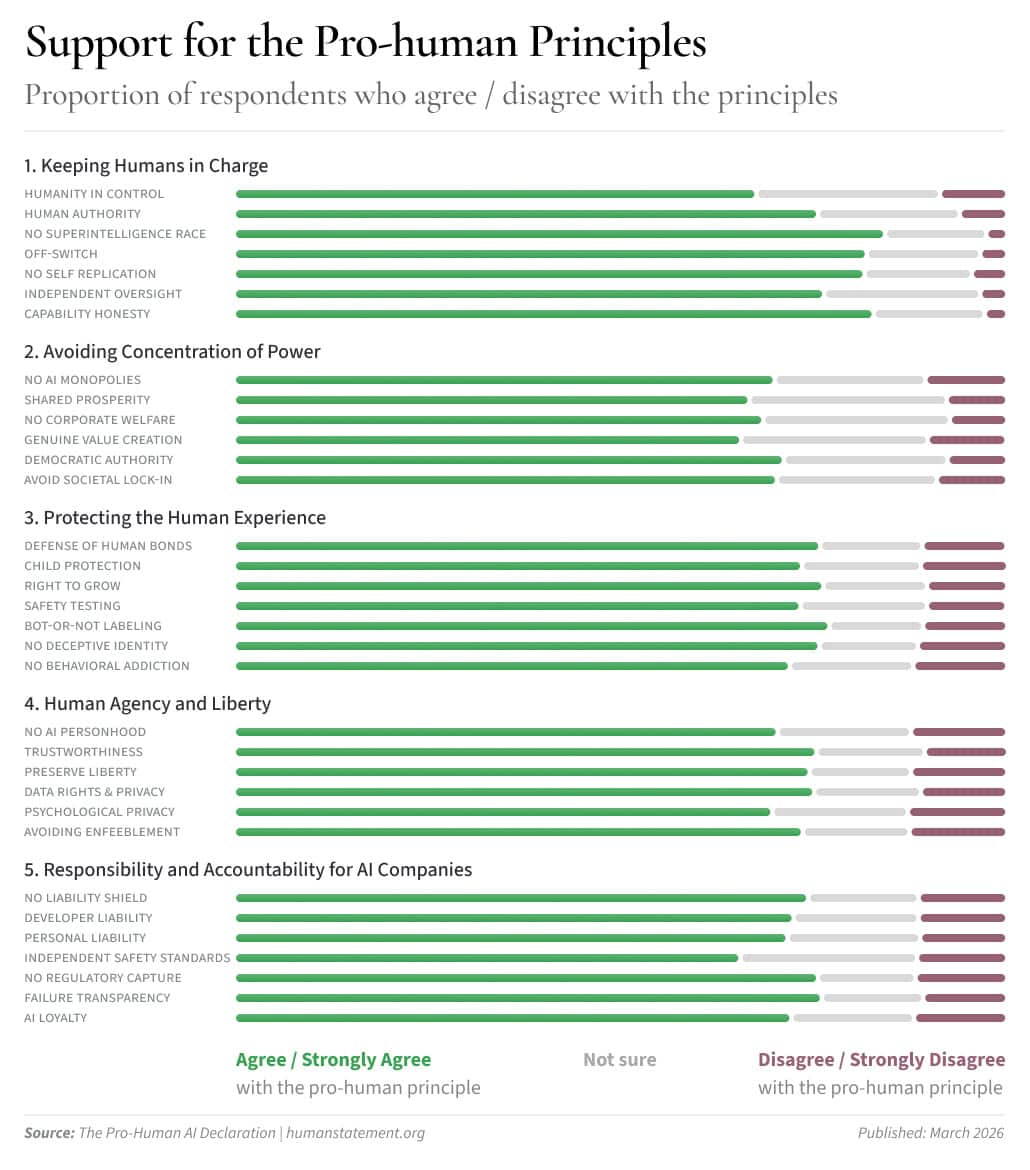
A new national survey of 1,004 likely U.S. voters (February 19-20, 2026) reveals where Americans stand on AI development and the principles that should guide it.
The findings show that voters overwhelmingly prefer a future that is pro-human in nature, and reject the AI race focused on human replacement.
Respondents were presented with pairs of opposing statements about the trajectory of AI and asked which they prefer. The results were remarkably clear: across the political spectrum voters reject the current paradigm of rapid, lightly regulated AI development. Instead they want humans to remain firmly in control, children protected from manipulative AI systems, and companies held legally accountable when AI causes harm.
These results come as policymakers grapple with how to govern increasingly powerful AI systems, and as leading AI companies push toward what they call "artificial general intelligence."
Below we summarize the key findings of this report. Click here to view the toplines.
Highlights
- 80% of voters support keeping humans in charge of AI, with strong oversight, clear limits, and corporate accountability—versus just 10% who favor fast, lightly regulated development.
- 77% believe AI must stay under human control, with people deciding what to delegate and retaining the ability to stop systems when needed—versus just 11% who prefer giving AI more independence for speed and scale.
- 69% want to prevent AI monopolies and ensure benefits are shared broadly, not captured by a small group—versus 16% who believe concentration is natural and policy shouldn't punish size with antitrust or forced sharing.
- 73% support protecting children and families from AI systems designed to create emotional attachment or dependency—versus 15% who feel AI should be allowed to serve as tutors, coaches, or companions without strict limits.
- 72% believe AI companies should bear legal responsibility for harms, with clear safety standards and real oversight—versus 15% who want accountability focused narrowly on negligence and fraud, with light oversight and safe harbors.
- 69% agree that superintelligence should be prohibited until there is broad scientific consensus it can be developed safely and controllably—versus just 9% who disagree.
Respondents were presented with competing framings of AI governance—one emphasizing human control and accountability, the other emphasizing speed and minimal regulation—and asked to choose.
They were also asked to rate their agreement with specific principles across five domains: human control, concentration of power, protecting human experience, human agency and liberty, and corporate accountability.
Bipartisan consensus on AI principles
Notably, these findings cut across partisan lines. The survey sample was weighted to reflect the 2024 electorate, with roughly equal numbers of Trump and Harris voters represented.
The pattern is consistent: while Harris voters show slightly stronger support for oversight and accountability, Trump voters still favor these positions by large margins.
On no issue tested did a majority of either partisan group choose the "fast development, minimal regulation" position.
This bipartisan consensus suggests that AI governance need not be a partisan issue. Voters of all political stripes want humans in charge, children protected, and companies held accountable.
Overall: Voters reject the "race to replace" approach to AI
When presented with two overarching visions for AI development, voters chose decisively.
This 8-to-1 margin represents a clear public mandate: Americans want guardrails on AI development, not a race to the bottom.
And what’s more:
- 89% of Harris voters chose the pro-human-control vision (Statement A);
- 73% of Trump voters chose the pro-human-control vision (Statement A), and of those only 14% preferred the fast, lightly-regulated approach.
On the core question of human control versus fast development, both Democrats and Republicans overwhelmingly chose human control. The same pattern holds across all the specific principles tested.
The finding sits in stark contrast to the operating paradigm of leading AI companies, which openly declare they are racing toward increasingly powerful systems while lobbying against meaningful oversight.
Human control: Non-negotiable for most Americans
The survey tested voter attitudes on several dimensions of human control over AI systems. The results show overwhelming consensus.
On the core question of human control:
- 77% agree that AI must stay under human control, with people deciding what to delegate and retaining the ability to understand what systems are doing and stop them when needed. Just 11% preferred giving AI more independence to enable speed and scale.
On specific control mechanisms:
- 83% agree that powerful AI systems must have mechanisms allowing human operators to promptly shut them down.
- 85% agree that humans should have the authority and capacity to understand, guide, limit, and override AI systems.
- 76% agree that AI systems must not be designed to self-replicate, autonomously self-improve, resist shutdown, or control weapons of mass destruction.
On superintelligence:
- 69% agree that development of superintelligence should be prohibited until there is broad scientific consensus that it can be done safely and controllably, with strong public support. Just 9% disagree.
This finding echoes earlier polling showing Americans want regulation or prohibition of superhuman AI systems. The public is not persuaded by industry claims that such systems are inevitable or that racing to build them is wise.
Protecting children and relationships from AI replacement and manipulation
The survey revealed strong support for protecting what might be called the "human experience" from AI encroachment—particularly when it comes to children.
On AI and children:
- 77% agree that companies must not be allowed to exploit children or undermine their wellbeing through AI interactions that create emotional attachment or leverage.
- 76% agree that AI companies should not be allowed to stunt children's physical, mental, or social growth or deprive them of essential developmental experiences.
On AI and relationships:
- 73% chose the view that AI should not replace meaningful relationships (family, friends, faith, community) and that children deserve extra protection—versus 15% who felt AI should be allowed to serve as tutors, coaches, or companions if users want.
- 72% agree that AI should not supplant the foundational relationships that give life meaning.
On safety testing and transparency:
- 74% agree that AI chatbots should undergo pre-deployment safety testing for risks such as increased suicidal ideation, worsening mental health, and other known harms—similar to how drugs are tested.
- 77% agree that AI-generated content that could be mistaken for human content must be clearly labeled.
- 78% agree that AI should clearly identify itself as artificial and not claim experiences it does not have.
- 74% agree that AI systems should not cause addiction or compulsive use through manipulation, sycophantic validation, or attachment formation.
These findings suggest the public sees AI's potential to manipulate vulnerable users—especially children—as a serious concern requiring regulatory action, and that a large majority do not want authentic human experiences replaced by AI.
Accountability: The public wants consequences
Voters strongly favor holding AI companies legally accountable for harms caused by their systems. They reject the idea that AI can serve as a shield against liability.
On corporate accountability:
- 72% chose the view that AI builders must be responsible for harms, with clear safety standards and honest reporting—versus 15% who preferred focusing accountability only on "real negligence and fraud" with light oversight.
- 71% agree that AI must not act as a liability shield that prevents those deploying it from being legally responsible.
- 73% agree that developers and deployers should bear legal liability for defects, misrepresentation of capabilities, and inadequate safety controls.
- 77% agree that if an AI system causes harm, it should be possible to determine why and who is responsible.
On oversight and standards:
- 72% agree that AI development should be governed by independent safety standards and rigorous oversight.
- 77% agree that highly autonomous AI systems should require pre-development review and independent oversight with genuine authority—not just industry self-regulation.
- 72% agree that AI companies must not be allowed undue influence over the rules that govern them.
On criminal penalties:
- 77% agree there should be criminal penalties for executives responsible for prohibited child-targeted AI systems or ones causing catastrophic harm.
On honest representations:
- 83% agree that AI companies must provide clear, accurate, and honest representations of their systems' capabilities and limitations.
The message is clear: the public expects AI companies to be held to high standards, with real consequences for failures.
Conclusion
This survey reveals a significant gap between public preferences for a pro-human future and the current trajectory of AI development.
Leading AI companies have declared they are racing toward artificial general intelligence, while many actively work to prevent meaningful oversight. The public, by contrast, wants humans firmly in control, with strong guardrails, independent oversight, and real accountability.
The findings represent a clear mandate for policymakers: Americans want AI that serves people, not the other way around. They want development that is careful and accountable, not fast and reckless. And they want rules with teeth, not industry self-regulation.
The Pro-Human Declaration principles tested in this survey reflect these values. As AI systems grow more powerful, the question is whether governance will catch up to public expectations—or whether the gap between what Americans want and what they are being given will continue to widen.

Organizations
Individual endorsers
Yoshua Bengio Professor, Université de Montréal, Turing Award Laureate
Steve Bannon Fmr Executive Chairman of Breitbart News; fmr chief strategist to President Donald Trump; Host of War Room podcast
Susan Rice Fmr U.S. National Security Advisor & Policy Adunder President Obama; U.S. Ambassador to the United Nations; Rhodes Scholar
Glenn Beck Founder of Blaze media, radio host, TV personality, political commentator
Alan Minsky Progressive Democrats of America (PDA)
Walter Kim President, National Association of Evangelicals, board member, Christianity Today
Ralph Nader Consumer Advocate, Center for Study of Responsive Law, Presidential candidate
Daron Acemoğlu Nobel Laureate in Economics, MIT Institute Professor
Beatrice Fihn Nobel Peace Laureate, Founder of Lex International
Rev. Johnnie Moore, PhD President, The Congress of Christian Leaders
Margarita Louis Dreyfus Human Change Foundation, Owner and chair of the Louis Dreyfus Company group, founder of Human Change Foundation
Sir Richard Branson Founder, Virgin Group
Randi Weingarten President, American Federation of Teachers
Julianna Arnold Founding Member and Executive Director, Parents RISE!
Megan Garcia Blessed Mother Family Foundation
Joann Bogard Parents SOS
Michael Toscano Director, Family First Technology Initiative, Senior Fellow, Institute for Family Studies
Mike Kubzansky CEO, Omidyar Network, Professor of Computational Engineering, Rice University, Member: US National Academy of Engineering and National Academy of Sciences
Tomicah Tillemann President, Project Liberty Institute
Stuart Russell Professor of Computer Science, Berkeley, Director of the Center for Human-Compatible Artificial Intelligence (CHAI); Co-author of the standard textbook 'Artificial Intelligence: a Modern Approach'
Tristan Harris Co-Founder, Center for Humane Technology
Brendan Steinhauser CEO, The Alliance for Secure AI
Dawn Nakagawa President, Berggruen Institute
Mikhail Samin Executive director, AI Governance and Safety Institute
Jeffrey Bennett General Counsel, SAG-AFTRA
Joseph-Gordon Levitt Actor, Filmmaker, Founder, HITRECORD
Alyson Stoner Actress, dancer, and singer, SAG-AFTRA, known for Step Up, Camp Rock, and voicing Isabella in Phineas and Ferb.
Frances Fisher Actress, SAG-AFTRA, known for Titanic, Unforgiven, and Watchmen.
Anthony Aguirre Future of Life Institute
Max Tegmark Future of Life Institute
Clark Barrett Professor of Computer Science, Stanford
Moshe Vardi Professor of Computational Engineering, Rice University, Member: US National Academy of Engineering and National Academy of Sciences
David Autor Professor, Co-director, Stone Center on Inequality and Shaping the Future of Work, MIT Department of Economics,
Meredith Whittaker President, Signal Foundation
Emilia Javorsky Future of Life Institute
Jean Oelwang Founding CEO, Virgin Unite and Planetary Guardians
Andrea Miotti Founder and CEO, ControlAI
Marc Rotenberg Founder, Center for AI and Digital Policy
Malo Bourgon Machine Intelligence Research Institute
Michael Marinaccio Executive Director, Center for Responsible Technology
Kelly Monroe Kullberg General Secretary, American Association of Evangelicals (AAE)
Dylan Hadfield-Menell Associate Professor of Computer Science, MIT
Sharon Li Associate Professor of Computer Science, University of Wisconsin Madison
Vael Gates Humans in Control
Deger Turan Metaculus
Ed Newton-Rex CEO, Fairly Trained
Alison Rice Managing Director, Design It For Us
Brooke Istook Chief Impact Officer, Heat Initiative
Medlir Mema Founder and Director, AI Ethics and Governance Institute; Senior Fellow, Organized Intelligence
Vivian Dong Programs Director, Legal Advocates for Safe Science and Technology
Tegan Maharaj Assistant Professor in Machine Learning, Mila
David Krueger CEO, Evitable; Assistant Professor, University of Montreal, Mila
Roman Yampolskiy Professor, Computer Science and Engineering. Author, AI: Unexplainable, Unpredictable, Uncontrollable, UofL
Jillian Clare LA Board Member, Chair National Young Performer’s Committee, SAG-AFTRA
Nick Smoke Actor, SAG-AFTRA, known for "The Social Network"
Karen A. Brown Filmmaker/Actor, SAG-AFTRA/StardustBlue Media
Jesse Martinez Carlos Board Member, Los Angeles Local, SAG-AFTRA
Erik Passoja Co-Chair, LA New Technology Committee (2024-2025), SAG-AFTRA
Peggy Lane ORourke Actress, known from Seinfeld; SAG AFTRA Los Angeles Local Board Member, National Board Alternate
Rob Drake Out There Pictures
Joshua Hughes Greater Grace Christian Center
Cristine Legare UT Austin
Mark Brakel Future of Life Institute
Joe Allen Humans First
Alexandra Tsalidis Future of Life Institute
DZ Kalman Shalom Hartman Institute
David Hsu Senior Director of Programs and Policy, Omidyar Network
Bobby Halick Hit Record
Justin Bullock Americans for Responsible Innovation
Oliver Stephenson Federation of American Scientists
Daniel Bring American Affairs
Michael Kleinman Future of Life Institute
Prof. Sandra M Faber Prof. Emerita, University of California, Santa Cruz
Kate McCarthy Women's Media Center
Brett Puterbaugh The Church of Jesus Christ of Latter-day Saints
William Jones Future of Life Institute
Juliana Arnold Parent RISE!
Colin McGlynn Demand Progress Education Fund
Rabbi Geoff Mitelman Sinai and Synapses
John Unger FAITH Alliance—Fellowship Advancing Integrity in Technology & Humanity
David Haussler Professor, UC Santa Cruz
Beatrice Ekers Foresight Institute
Evan Davison Kotler Helena
Ari Rosenthal Torchbearer Community
Connor Leahy ControlAI US
Fr. Michael Baggot Associate Professor of Bioethics, Pontifical Athenaeum Regina Apostolorum
Sugheanmungol Sarin AI Safety Asia
Isabella Hampton Future of Life Institute
Joshua Tan Public AI
Jeremy Ornstein Center for AI Safety
Emma Ruby Sachs Eko
Philip Reiner Institute for Security and Technology
Sam Hiner Young People's Alliance
Lachlan Carroll Center for AI Safety
Riki Parikh Alliance for Secure AI
Christian F. Nunes President, Saving Ourselves Foundation Inc.
Brian Boyd Future of Life Institute
Chase Hardin Future of Life Institute
Dalia Hashad Future of Life Institute
Saheb Gulati Center for AI Safety
Lucas Hansen CivAI
Marianna Richardson G20 Interfaith Forum Association
Sacha Hayworth Tech Oversight Project
Shana Mansbach Fathom
John McElliot Servitium AI and Serviti Corp
Holly Elmore Pause AI
Sander Volten Seismic Foundation
Jaron Lanier Computer Scientist, Author
Lizzie Irwin Policy Communications Specialist, Center for Humane Technology
Valerie M. Hudson University Distinguished Professor, Texas A&M University (and the Aegix Institute)
Maurine Molak Founder, David’s Legacy Foundation
Ron Ivey Founder and CEO, Noēsis Collaborative
Kirk Doran, Associate Professor of Economics Faculty, University of Notre Dame
Maria S. Eitel Founder, Plan A
Geoffrey Miller Associate Professor of Psychology, University of New Mexico
Camille Crittenden Executive Director, CITRIS and the Banatao Institute, University of California
Joseph Vukov Associate Professor of Philosophy, Loyola University Chicago
David Evan Harris Chancellor's Public Scholar, University of California, Berkeley
Zachary Davis Co-Founder, Faith Matters
Seán Coughlan Director, To Zero
Andrew Broz AI Research & Strategy, Civilization Research Institute
David Brenner Co-Founder and Board Chair Emeritus, AI and Faith
Emilia Ismael Head of Communications & Operations, To Zero
Miki Yamashita Actor, SAG-AFTRA
Heather-Ashley Boyer Actor, Los Angeles Local Board Member, SAG-AFTRA
Anamitra Deb SVP, Programs and Policy, Omidyar Network
Catherine Bracy CEO & Founder, Tech Equity
Marie Fink Stunt Coordinator, SAG-AFTRA, Los Angeles National Board Member
Wes McEnany Future of Life Institute
Konstantine Anthony Councilmember, City of Burbank
Taylor Jones Design & Web Manager, Future of Life Institute
Stephen Casper AI researcher, Massachusetts Institute of Technology
Ron Ivey Noesis Collaborative
Kelly Kullberg American Association of Evangelicals, Veritas Forum
Ben Cumming Director of Communications, Future of Life Institute
Tristan Zucker Head of Operations, Humans First
Nancy Green Saraisky Executive Director, Ethical Tech Project
Anna Yelizarova Special Projects Lead, Future of Life Institute
John Richard President, Essential Information
Ryan T. Anderson President, The Ethics and Public Policy Center
Clare Morell Fellow, The Ethics and Public Policy Center
Lisa Gilbert Co-President, Public Citizen
Robert Weissman Co-President, Public Citizen
Vivian Dong Programs Director, Legal Advocates for Safe Science and Technology
Teri Olle Vice President, Economic Security Project
Brendan Bradley
Michelle Margolis Librarian, Columbia University
Colin McGlynn AI Policy Advisor, Demand Progress Education Fund
Sneha Revanur Founder & President, Encode
Heather Booth Organizer
Robert Creamer Partner, Democracy Partners
Brittney Gallagher Co-Founder, AI Objectives Institute
Rania Batrice Strategist, Founder and President, Batrice and Associates
Leah Seligmann CEO, The B Team
Hon Jeff Denham US Representative- CA 10 (2011-2019)
Andrew Trask Executive Director, OpenMined
Lawrence Lessig Roy L. Furman Professor of Law and Leadership, Harvard University