

More than eight in ten U.S. voters back human oversight of AI systems, reject fast-and-loose development, and want AI companies held accountable for harms.
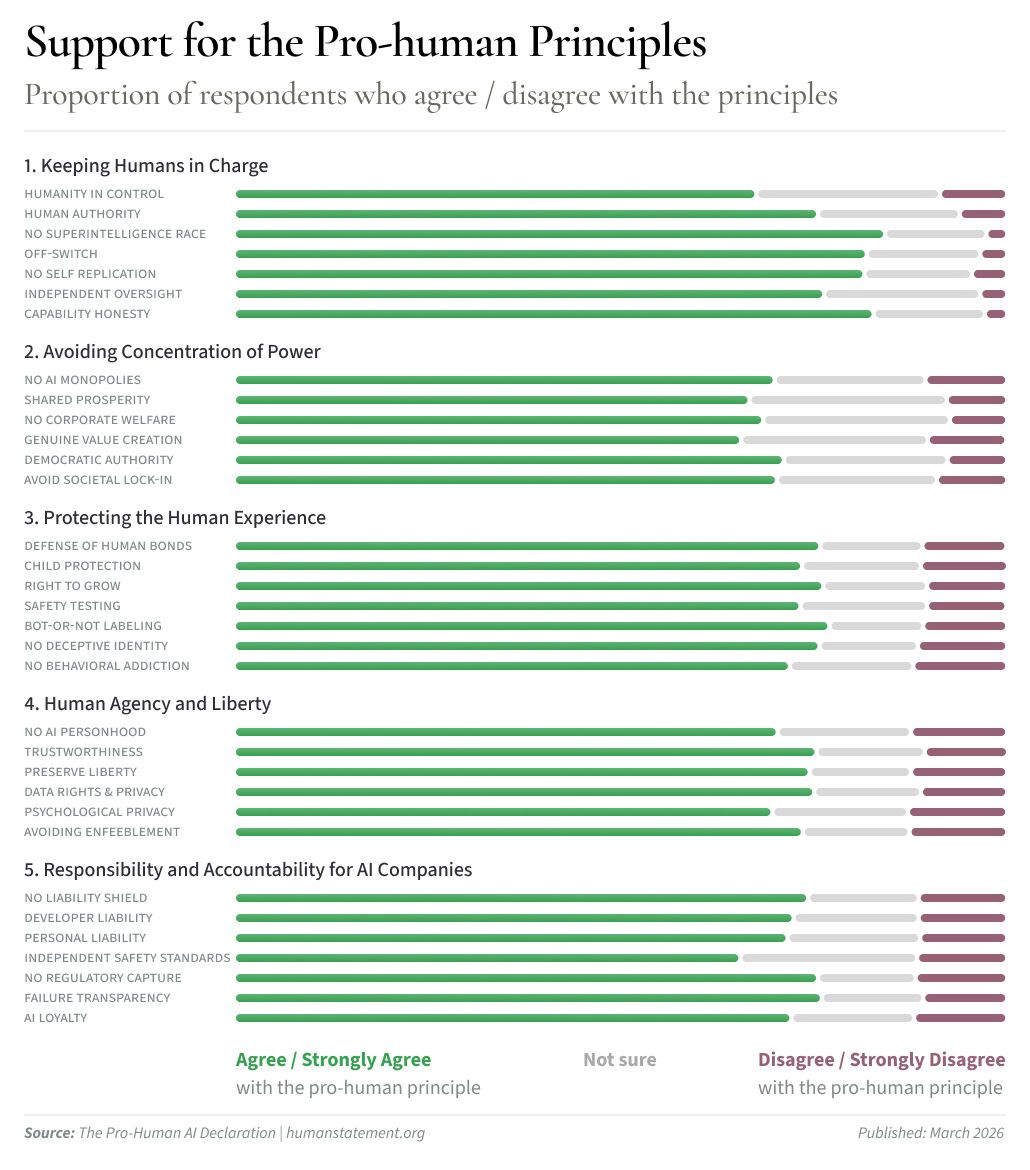
A new national survey of 1,004 likely U.S. voters (February 19-20, 2026) reveals where Americans stand on AI development and the principles that should guide it.
The findings show that voters overwhelmingly prefer a future that is pro-human in nature, and reject the AI race focused on human replacement.
Respondents were presented with pairs of opposing statements about the trajectory of AI and asked which they prefer. The results were remarkably clear: across the political spectrum voters reject the current paradigm of rapid, lightly regulated AI development. Instead they want humans to remain firmly in control, children protected from manipulative AI systems, and companies held legally accountable when AI causes harm.
These results come as policymakers grapple with how to govern increasingly powerful AI systems, and as leading AI companies push toward what they call "artificial general intelligence."
Below we summarize the key findings of this report. Click here to view the toplines.
Highlights
- 80% of voters support keeping humans in charge of AI, with strong oversight, clear limits, and corporate accountability—versus just 10% who favor fast, lightly regulated development.
- 77% believe AI must stay under human control, with people deciding what to delegate and retaining the ability to stop systems when needed—versus just 11% who prefer giving AI more independence for speed and scale.
- 69% want to prevent AI monopolies and ensure benefits are shared broadly, not captured by a small group—versus 16% who believe concentration is natural and policy shouldn't punish size with antitrust or forced sharing.
- 73% support protecting children and families from AI systems designed to create emotional attachment or dependency—versus 15% who feel AI should be allowed to serve as tutors, coaches, or companions without strict limits.
- 72% believe AI companies should bear legal responsibility for harms, with clear safety standards and real oversight—versus 15% who want accountability focused narrowly on negligence and fraud, with light oversight and safe harbors.
- 69% agree that superintelligence should be prohibited until there is broad scientific consensus it can be developed safely and controllably—versus just 9% who disagree.
Respondents were presented with competing framings of AI governance—one emphasizing human control and accountability, the other emphasizing speed and minimal regulation—and asked to choose.
They were also asked to rate their agreement with specific principles across five domains: human control, concentration of power, protecting human experience, human agency and liberty, and corporate accountability.
Bipartisan consensus on AI principles
Notably, these findings cut across partisan lines. The survey sample was weighted to reflect the 2024 electorate, with roughly equal numbers of Trump and Harris voters represented.
The pattern is consistent: while Harris voters show slightly stronger support for oversight and accountability, Trump voters still favor these positions by large margins.
On no issue tested did a majority of either partisan group choose the "fast development, minimal regulation" position.
This bipartisan consensus suggests that AI governance need not be a partisan issue. Voters of all political stripes want humans in charge, children protected, and companies held accountable.
Overall: Voters reject the "race to replace" approach to AI
When presented with two overarching visions for AI development, voters chose decisively.
Statement A described an approach where AI serves people, and does not replace them; where humans stay in charge, society prevents concentration of power, children and relationships are protected, privacy rights are strong, and companies are held accountable for harms.
80% support
Statement B described an approach where AI progress moves fast, heavy rules are avoided, safety comes mainly from engineering and real-world testing rather than regulation, and markets decide what works.
10% support
This 8-to-1 margin represents a clear public mandate: Americans want guardrails on AI development, not a race to the bottom.
And what’s more:
- 89% of Harris voters chose the pro-human-control vision (Statement A);
- 73% of Trump voters chose the pro-human-control vision (Statement A), and of those only 14% preferred the fast, lightly-regulated approach.
On the core question of human control versus fast development, both Democrats and Republicans overwhelmingly chose human control. The same pattern holds across all the specific principles tested.
The finding sits in stark contrast to the operating paradigm of leading AI companies, which openly declare they are racing toward increasingly powerful systems while lobbying against meaningful oversight.
Human control: Non-negotiable for most Americans
The survey tested voter attitudes on several dimensions of human control over AI systems. The results show overwhelming consensus.
On the core question of human control:
- 77% agree that AI must stay under human control, with people deciding what to delegate and retaining the ability to understand what systems are doing and stop them when needed. Just 11% preferred giving AI more independence to enable speed and scale.
On specific control mechanisms:
- 83% agree that powerful AI systems must have mechanisms allowing human operators to promptly shut them down.
- 85% agree that humans should have the authority and capacity to understand, guide, limit, and override AI systems.
- 76% agree that AI systems must not be designed to self-replicate, autonomously self-improve, resist shutdown, or control weapons of mass destruction.
On superintelligence:
- 69% agree that development of superintelligence should be prohibited until there is broad scientific consensus that it can be done safely and controllably, with strong public support. Just 9% disagree.
This finding echoes earlier polling showing Americans want regulation or prohibition of superhuman AI systems. The public is not persuaded by industry claims that such systems are inevitable or that racing to build them is wise.
Protecting children and relationships from AI replacement and manipulation
The survey revealed strong support for protecting what might be called the "human experience" from AI encroachment—particularly when it comes to children.
On AI and children:
- 77% agree that companies must not be allowed to exploit children or undermine their wellbeing through AI interactions that create emotional attachment or leverage.
- 76% agree that AI companies should not be allowed to stunt children's physical, mental, or social growth or deprive them of essential developmental experiences.
On AI and relationships:
- 73% chose the view that AI should not replace meaningful relationships (family, friends, faith, community) and that children deserve extra protection—versus 15% who felt AI should be allowed to serve as tutors, coaches, or companions if users want.
- 72% agree that AI should not supplant the foundational relationships that give life meaning.
On safety testing and transparency:
- 74% agree that AI chatbots should undergo pre-deployment safety testing for risks such as increased suicidal ideation, worsening mental health, and other known harms—similar to how drugs are tested.
- 77% agree that AI-generated content that could be mistaken for human content must be clearly labeled.
- 78% agree that AI should clearly identify itself as artificial and not claim experiences it does not have.
- 74% agree that AI systems should not cause addiction or compulsive use through manipulation, sycophantic validation, or attachment formation.
These findings suggest the public sees AI's potential to manipulate vulnerable users—especially children—as a serious concern requiring regulatory action, and that a large majority do not want authentic human experiences replaced by AI.
Accountability: The public wants consequences
Voters strongly favor holding AI companies legally accountable for harms caused by their systems. They reject the idea that AI can serve as a shield against liability.
On corporate accountability:
- 72% chose the view that AI builders must be responsible for harms, with clear safety standards and honest reporting—versus 15% who preferred focusing accountability only on "real negligence and fraud" with light oversight.
- 71% agree that AI must not act as a liability shield that prevents those deploying it from being legally responsible.
- 73% agree that developers and deployers should bear legal liability for defects, misrepresentation of capabilities, and inadequate safety controls.
- 77% agree that if an AI system causes harm, it should be possible to determine why and who is responsible.
On oversight and standards:
- 72% agree that AI development should be governed by independent safety standards and rigorous oversight.
- 77% agree that highly autonomous AI systems should require pre-development review and independent oversight with genuine authority—not just industry self-regulation.
- 72% agree that AI companies must not be allowed undue influence over the rules that govern them.
On criminal penalties:
- 77% agree there should be criminal penalties for executives responsible for prohibited child-targeted AI systems or ones causing catastrophic harm.
On honest representations:
- 83% agree that AI companies must provide clear, accurate, and honest representations of their systems' capabilities and limitations.
The message is clear: the public expects AI companies to be held to high standards, with real consequences for failures.
Conclusion
This survey reveals a significant gap between public preferences for a pro-human future and the current trajectory of AI development.
Leading AI companies have declared they are racing toward artificial general intelligence, while many actively work to prevent meaningful oversight. The public, by contrast, wants humans firmly in control, with strong guardrails, independent oversight, and real accountability.
The findings represent a clear mandate for policymakers: Americans want AI that serves people, not the other way around. They want development that is careful and accountable, not fast and reckless. And they want rules with teeth, not industry self-regulation.
The Pro-Human Declaration principles tested in this survey reflect these values. As AI systems grow more powerful, the question is whether governance will catch up to public expectations—or whether the gap between what Americans want and what they are being given will continue to widen.
Methodology: This survey was conducted online among 1,004 likely U.S. voters from February 19–20, 2026. The sample was weighted by gender, race, education, 2024 presidential vote, and age. Respondents were also weighted by performance on attention checks, which included questions about fictional politicians and policies. The margin of error is ±4.7 percentage points.
Exit and return to the declaration.